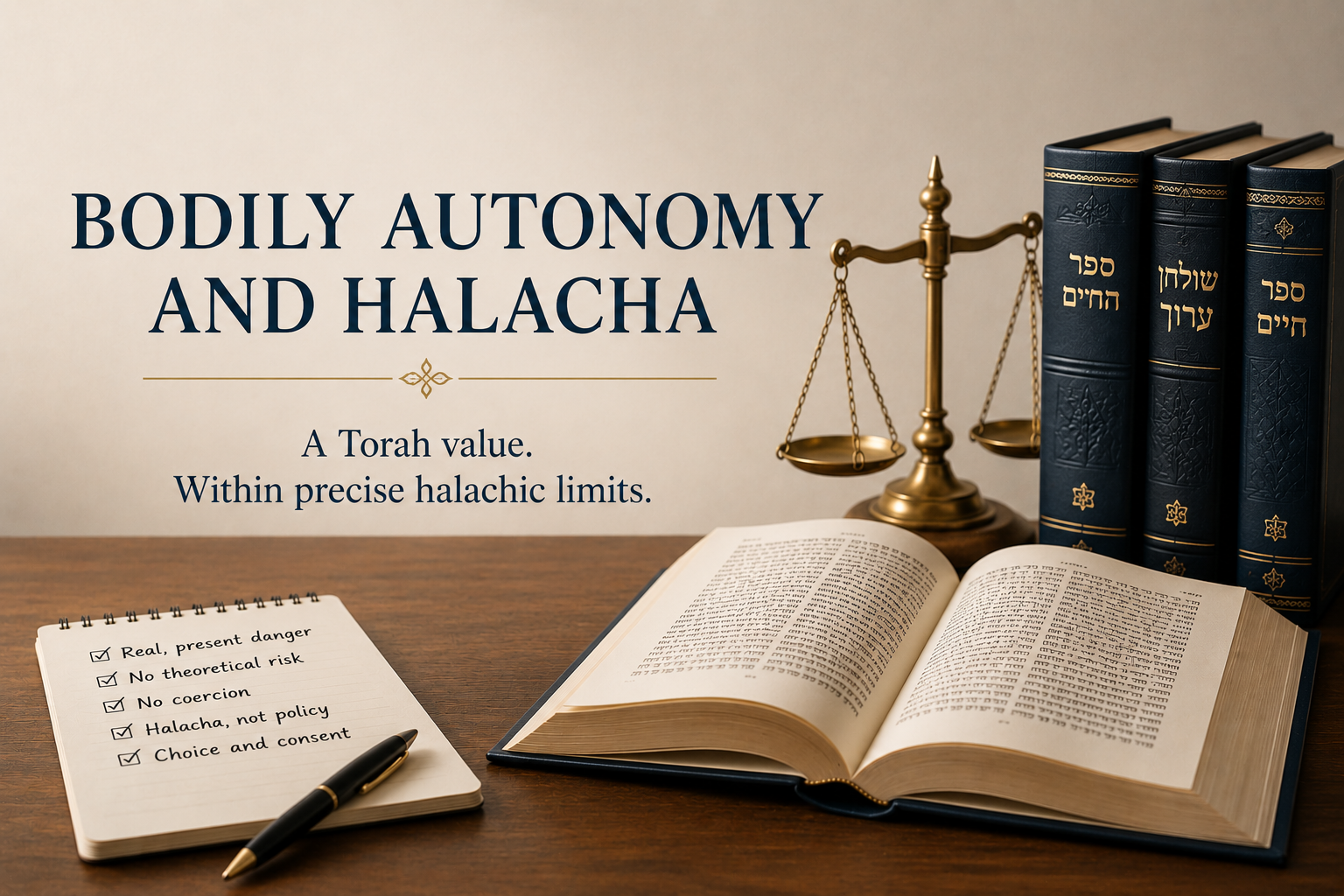
In his post, Bodily Autonomy and Halacha, Rabbi Michoel Green argues that bodily autonomy is a Torah value, within precise halachic limits.
Rabbi Green writes:
. . . Someone’s autonomy may not be violated unless the mortal risk to this individual is real and unambiguous. The medical expert must clinically observe the patient and determine that the patient is in fact ill. Further, the physician must diagnose the illness, and must confirm reasonable possibility that lack of nutrition might aggravate the patient’s condition. Mere speculation is insufficient.
Force-medicating is similar to force-feeding, provided that a medical expert has diagnosed patient with known life-threatening condition and prescribes a particular curative medicine or therapy.
However, here lies an important distinction. If the medical expert prescribes a procedure that also carries risks of its own, the patient has autonomy to decline, depending on the degree of risk versus benefit.
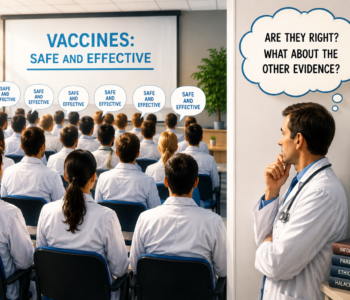
Rabbi Green applies this to vaccines, a medical procedure addressing a theoretical risk that may occur in the future; a healthy person faces no present danger. However, every injection carries some risk, and “public health policy” is not a factor in halacha. Mandatory vaccination, he argues, has no halachic basis, and a healthy child may not be excluded from public life for declining it.
He makes the following points:
- Freedom and personal independence are cherished Torah values — “the Children of Israel are My servants, not servants of servants.”
- Bodily autonomy can only be overridden when danger is real, present, and clinically confirmed. Not for a theoretical or statistical risk.
- Even to save someone else’s life, you cannot be compelled to accept risk to your own body — even minimal risk requires consent.
- Every injection constitutes a chavala (wound) and carries risk; therefore, the patient must have a choice
- The measles mortality rate of 1/1000 only justifies overriding Shabbos — and bodily autonomy — once the patient actually has measles, not before. [Editor’s note: The mortality rate is even lower, 1/500,000, when calculated based on CDC statistics. See My Vaccine Journey https://www.rodefshalom613.org/2019/11/my-vaccine-journey/ p.23.]
- “Public health policy” and “herd immunity” are not factors in halacha.
- In a purely halachic state, vaccination would not be enforced even during an outbreak.
- A healthy child may not be quarantined or barred from public life for not complying with a vaccine schedule.
Read Rabbi Green’s full post here: Bodily Autonomy and Halacha.