
This disease is back because we didn’t really understand how our immune defenses against whooping cough worked, and did not understand how the vaccines needed to work to prevent it. … Instead we layered assumptions upon assumptions, and now find ourselves in the uncomfortable position of admitting that we made some crucial errors…
Christopher J. Gill, associate professor of global health, Boston University School of Public Health quoted in Resurgence of Whooping Cough May Owe to Vaccine’s Inability to Prevent Infections
What is Whooping Cough?
Whooping cough, or pertussis, is a bacterial infection caused by the Bordetella pertussis bacterium. It gets its name from the characteristic “whoop” sound made when breathing in after coughing, often causing severe and violent coughing fits.
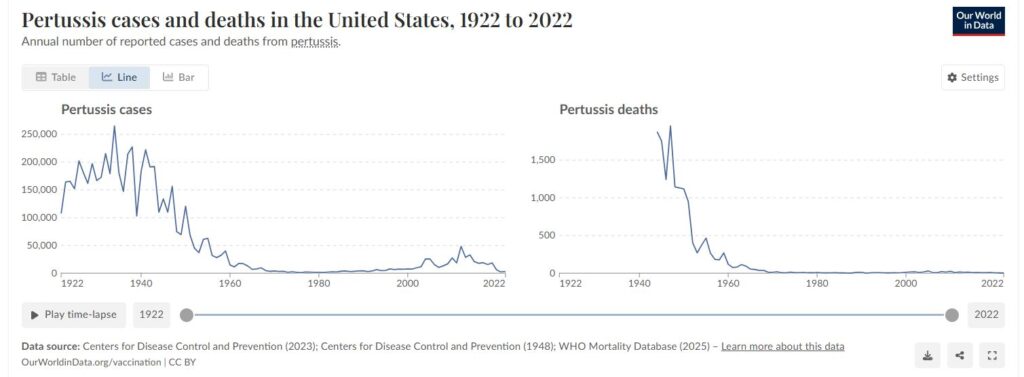
The following graph from Our World in Data, shows the incidence of pertussis cases and deaths in the US from 1940 to 2022.
However, the acellular pertussis vaccine (aP), part of the DTaP and TDaP recommended to prevent the disease, has two major flaws:
- Vaccine immunity wanes, so it does not provide long-term protection.
- It only mitigates symptoms. It does not prevent colonization and transmission of the bacteria.
Whooping cough can be treated with antibiotics if caught early enough, since the bacterium dies off naturally after three weeks.
Vaccine waning
A paper published in 2012 in the NEJM (New England Journal of Medicine) showed that vaccine effectiveness wanes very quickly after the last booster dose.
Immunity conferred by the aP (acellular pertussis) portion of the TDaP vaccine wanes quickly. The chances of getting pertussis rise by 42% each year after the last of five vaccine doses is given, at about 7 years of age.
This finding was echoed in 2017 by Dr. Stanley Plotkin (considered the Godfather of Vaccines) and co-authors who discussed the short protective period offered by the vaccine in their paper “What Is Wrong with Pertussis Vaccine Immunity? The Problem of Waning Effectiveness of Pertussis Vaccines.” From the abstract:
Although aP vaccines do provide protection during the first years of life, the change in T-cell priming results in waning effectiveness of aP as early as 2-3 years post-boosters… the increase in pertussis appears to be the result of waning immunity.
How waning immunity plays out in real populations
Following is a Facebook reel by pharmacist Dr. Brittanny Todd providing her opinion on why pertussis outbreaks are occurring, emphasizing that waning immunity among vaccinated individuals plays a significant role, rather than the lack of vaccination. From the description below the video:
Why are we having pertussis outbreaks?Pertussis cases are growing, but not in the unvaccinated! Why?The pertussis vaccine offers good protection for a year or two, but wanes to under 10% immunity by year four! That means, most people are walking around with subpar immunity to pertussis; allowing for infection and increasing spread.Natural immunity, contacting pertussis once, allows for almost lifelong immunity. The safest people to be around are those who have previously had pertussis!
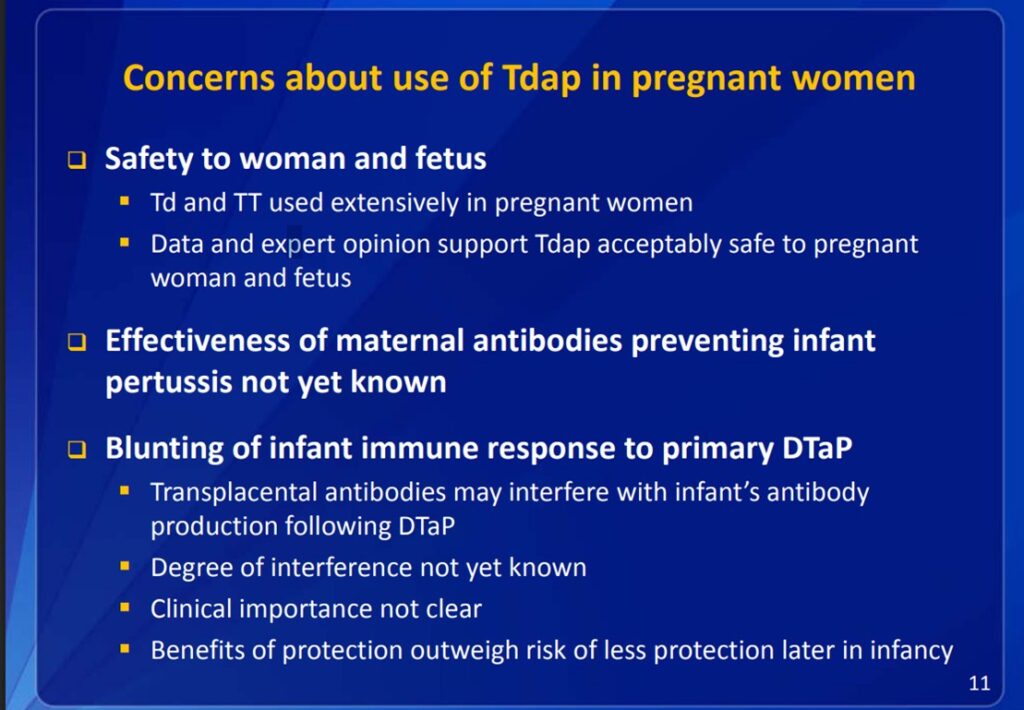
Dr. Todd mentions pregnancy as a reason to get the pertussis vaccine. The CDC recommends pregnant women receive the vaccine between 27 and 36 weeks of pregnancy for a 78% lower risk of infection in infants under 2 months. The CDC, in its May 2012 slide presentation “Preventing pertussis in infants: ACIP’s Tdap cocooning recommendations” recommended vaccinating pregnant women (slide 10) was because cocooning, vaccinating mothers immediately post-partum and family members and others who would be around babies under 12 months (slide 6), was not working at a national level, and they could not know if it was effective (slide 9).
However, the CDC also noted that the vaccine is only “acceptably safe” for pregnant women; it is not known how well maternal antibodies will protect the fetus; and there is concern that maternal antibodies may interfere with the infant’s production of antibodies following vaccination (Slide 11 below).
Vaccinated individuals can transmit infection
In their paper, Plotkin et al noted that the acellular vaccine (introduced in the US in 1997) is not as able to prevent colonization of the infection in the nose and throat as was the whole-cell vaccine:
In addition, studies in baboon models, requiring confirmation in humans, show that aP is less able to prevent nasopharyngeal colonization of Bordetella pertussis than wP or natural infection.
An FDA study found that baboons vaccinated with the acellular pertussis vaccine and exposed to pertussis afterwards show no symptoms of whooping cough. Yet, they were found to colonize the virus in their throats and transmit it to others for up to 35 days after vaccination.
Tod Merkel and his colleagues at the U.S. Food and Drug Administration suspected another weakness lurked in the acellular vaccine—that it might not block the spread of the disease. To test their hypothesis, Merkel’s team members infected baboons with pertussis. Some of the animals had been vaccinated, and some had acquired natural immunity from a past bout of the illness. None of the vaccinated or naturally immune baboons fell ill, but the bacterium lingered for 35 days in the throats of the baboons that had received the acellular vaccine…
During their infections, acellular-vaccinated baboons were able to pass the bacterium to unprotected animals…
This means that pregnant women or anyone who receives the pertussis vaccine may unwittingly remain capable of transmitting pertussis to newborn infants and others
Vaccines Don’t Stop Whooping Cough Outbreaks
Whooping cough outbreaks (like outbreaks of other “vaccine-preventable” illnesses) often occur in highly vaccinated populations.
In May 2024, reports emerged of whooping cough outbreaks across multiple U.S. states, the U.K., and Australia. In the following video, Del Bigtree reviews why such epidemics are occurring, pointing to the limitations of current pertussis vaccines.
Once waning immunity and continued transmission are taken into account, outbreaks in highly vaccinated populations are not unexpected. Below are reports of whooping cough epidemics in highly vaccinated populations.
- Temporal Trends in the Population Structure of Bordetella pertussis during 1949–1996 in a Highly Vaccinated Population
- Why did so many California kids get whooping cough despite being vaccinated?
- Whooping Cough Outbreak In Alabama Spread By Vaccinated Children
- Pertussis infection in fully vaccinated children in day-care centers, Israel
(The children in Israel received the DPT vaccine, a whole virus vaccine, which is no longer used in the US
because of the degree of associated adverse events.) - Harvard-Westlake students were vaccinated. Dozens caught whooping cough anyway
- Pertussis outbreak in an elementary school with high vaccination coverage
Feature image by cottonbro studio